
Ram 1500/2500/3500: Manual Seat Adjuster - If Equipped
Both front seats are adjustable forward or rearward. The manual seat adjustment handle is located under the seat cushion at the front edge of each seat.
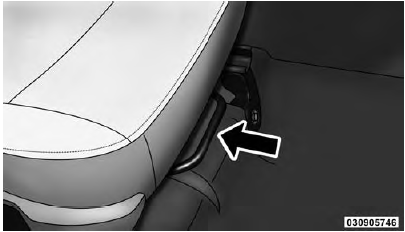
Manual Seat Adjuster
While sitting in the seat, pull up on the handle and slide the seat forward or backward. Release the bar once you have reached the desired position. Then, using body pressure, move forward and rearward on the seat to be sure that the seat adjusters have latched.
WARNING!
- Adjusting a seat while driving may be dangerous.
Moving a seat while driving could result in loss of control which could cause a collision and serious injury or death.
- Seats should be adjusted before fastening the seat belts and while the vehicle is parked. Serious injury or death could result from a poorly adjusted seat belt.
Dump Feature (Manual Recline Seat Only) - Standard Cab
Actuating the recliner handle will allow the seatback to swing (dump) forward on manual recliner seats. This "dump" feature allows access to the storage bin behind the seat.
WARNING!
- Do not stand or lean in front of the seat while actuating the handle. The seatback may swing forward and hit you causing injury.
- To avoid injury, place your hand on the seatback and actuate the handle, then position the seatback in the desired position.
40-20-40 Front Bench Seat - If Equipped
The seat is divided into three segments. The outboard seat portions are each 40% of the total width of the seat.
On some models the back of the center portion (20%) easily folds down to provide an armrest/center storage compartment.
READ NEXT:
 Mega Cab Rear Seat Features
Reclining Rear Seats - If Equipped
The recliner handle is located on the outside of the seat
cushion. To adjust the seatback, lift upward on the
handle, lean back on the seatback and when you reach
th
Head Restraints
Head restraints are designed to reduce the risk of injury
by restricting head movement in the event of a rear
impact. Head restraints should be adjusted so that the top of the head restraint
is locat
Driver Memory Seat - If Equipped
This feature allows the driver to store up to two different
memory profiles for easy recall through a memory
switch. Each memory profile contains desired position
settings for the driver seat, side mi
SEE MORE:
Appearance Care And Protection
From Corrosion
Protection Of Body And Paint From Corrosion
Vehicle body care requirements vary according to geographic
locations and usage. Chemicals that make roads
passable in snow and ice and those that are sprayed on
trees and road surfaces during other seasons are highly
corrosive to the metal in your vehicle
Vehicle Storage
If you are storing your vehicle for more than 21 days, we
recommend that you take the following steps to minimize
the drain on your vehicle's battery:
Disconnect the negative cable from battery.
Any time you store your vehicle or keep it out of
service (i.e., vacation) for two weeks or more, run
